# How to book a leasing invoice
**URL:** https://discuss.tryton.org/t/how-to-book-a-leasing-invoice/2254
**Category:** User
**Created:** [January 29, 2020, 9:12pm UTC](https://discuss.tryton.org/t/how-to-book-a-leasing-invoice/2254 "2020-01-29T21:12:07Z")
**Posts on this page:** 17
**Page:** 1
### Author:  [@josesalvador](https://discuss.tryton.org/u/josesalvador)
#### Post date: [January 29, 2020, 9:12pm UTC](https://discuss.tryton.org/t/how-to-book-a-leasing-invoice/2254/1 "2020-01-29T21:12:07Z")
A **lease** is a [contractual](https://en.wikipedia.org/wiki/Contract) arrangement calling for the [lessee](https://en.wiktionary.org/wiki/lessee) (user) to pay the [lessor](https://en.wikipedia.org/wiki/Lessor_(leasing)) (owner) for use of an asset. ([english source: wikipedia](https://en.wikipedia.org/wiki/Lease); [spanish source: wikipedia](https://es.wikipedia.org/wiki/Arrendamiento_financiero)).
At least in Spain (and I guess in another countries too), the financial entity charges you a quote by the leasing contract through an invoice with taxes.
The problem here is that one of the invoice lines (“product”) account is not an expense or revenue account, so I cannot select it then I do not know how I should book that invoice.
These are the move lines:
```
5240001 100,00 (debit)
6623001 50,00 (debit)
4720001 31,50 (debit)
4100007 181,50 (credit)
```
> 5240001: Not an expense nor revenue account
> 6623001: Expense account
> 4720001: Payable account (Tax)
> 4100007: Payable account
Someone can help here?
---
### Author:  [@ced](https://discuss.tryton.org/u/ced)
#### Post date: [January 29, 2020, 10:42pm UTC](https://discuss.tryton.org/t/how-to-book-a-leasing-invoice/2254/2 "2020-01-29T22:42:56Z")
This sounds very weird to want to use a balance account for a invoice line.
Could you explain the rational for such usage?
---
### Author:  [@josesalvador](https://discuss.tryton.org/u/josesalvador)
#### Post date: [January 30, 2020, 11:57am UTC](https://discuss.tryton.org/t/how-to-book-a-leasing-invoice/2254/3 "2020-01-30T11:57:56Z")
> [@ced](#):
>
> Could you explain the rational for such usage?
**Record a real invoice as an invoice in Tryton.**
The invoice:
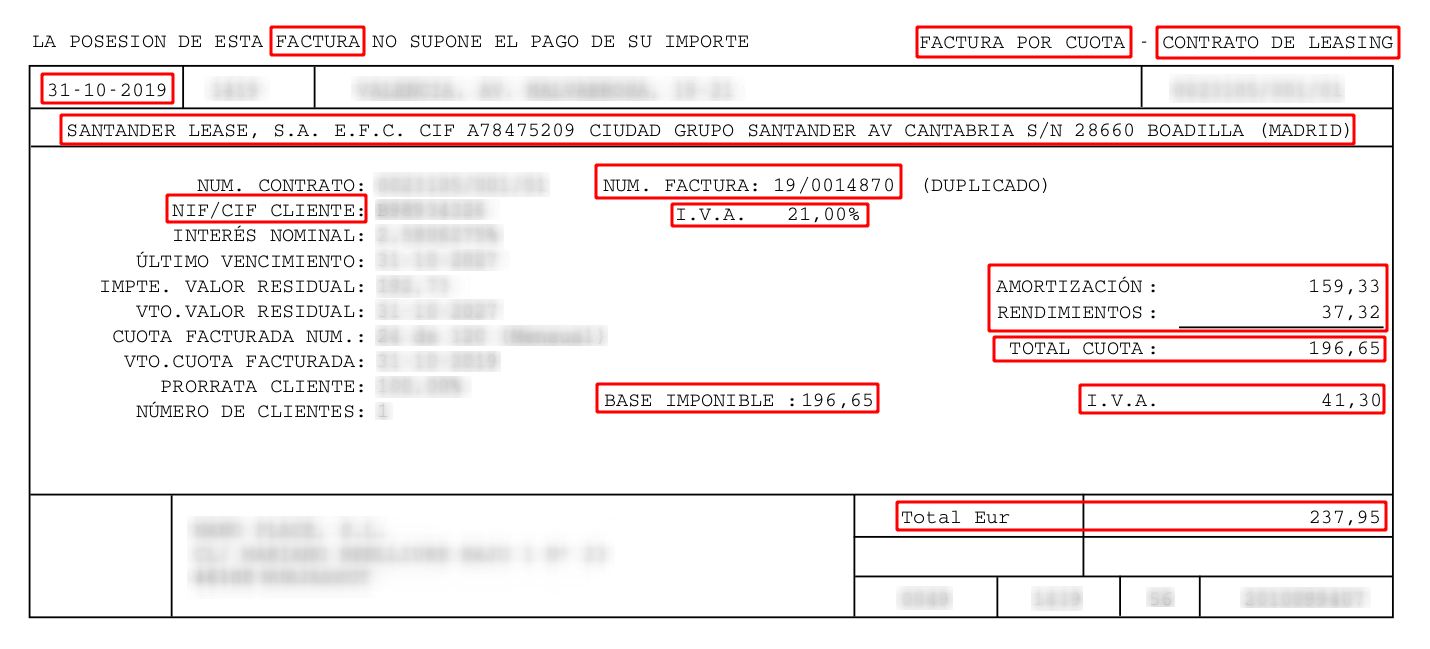
> Factura: Invoice
> Factura por cuota: Invoice by quote
> Contrato de leasing: Leasing contract
> Santander Lease…: party (financial entity)
> NIF/CIF cliente: Customer tax identifier
> Num. Factura: Invoice number
> I.V.A.: Tax percentage applicable
> Amortización: Invoice line (to book to an account type distinct from revenue or expense - **this is the problem** )
> Rendimientos: Invoice line (to book to an expense account)
> Total cuota: Total invoice amount excluding taxes
> Base imponible: The same as above
> I.V.A.: Total taxes amount
> Total Eur: Total invoice amount including taxes
---
### Author:  [@ced](https://discuss.tryton.org/u/ced)
#### Post date: [January 30, 2020, 12:39pm UTC](https://discuss.tryton.org/t/how-to-book-a-leasing-invoice/2254/4 "2020-01-30T12:39:36Z")
OK so the amortization is directly booked from the invoice.
So for me, you need to `account_asset` module and have the type “Acreedores por arrendamiento financiero” set as fixed asset. But I would not create a product for this case because you are not managing a depreciation (or only at the end of the leasing).
---
### Author:  [@josesalvador](https://discuss.tryton.org/u/josesalvador)
#### Post date: [January 30, 2020, 8:19pm UTC](https://discuss.tryton.org/t/how-to-book-a-leasing-invoice/2254/5 "2020-01-30T20:19:00Z")
I’ve not got this module installed.
I’ll try to find out some available time to follow your instructions, set up the new module and do some tests. Later I’ll report back.
Thank you @ced.
---
### Author:  [@josesalvador](https://discuss.tryton.org/u/josesalvador)
#### Post date: [February 7, 2020, 9:38am UTC](https://discuss.tryton.org/t/how-to-book-a-leasing-invoice/2254/6 "2020-02-07T09:38:27Z")
> [@ced](#):
>
> and have the type “Acreedores por arrendamiento financiero” set as fixed asset
@pokoli Would we define this type in account\_es as ced says as default?
if not, what collateral effects has to override the template as ced suggests?
---
### Author:  [@pokoli](https://discuss.tryton.org/u/pokoli)
#### Post date: [February 10, 2020, 2:47pm UTC](https://discuss.tryton.org/t/how-to-book-a-leasing-invoice/2254/7 "2020-02-10T14:47:55Z")
> [@josesalvador](#):
>
> @pokoli Would we define this type in account\_es as ced says as default?
I do not see this is possilbe as fixed assets are only for assets but this account is not an asset but a creditor account. Normally this account is used as counterpart of the asset in order to record the liabilty that you have to pay the total amount of the leasing to the leaser.
I’m wondering if it won’t be better to include a check (probably on account\_asset module) to indicate that the account is fixed asset liability and include them on the invoice. So we allow to include also this kind of accounts on invoices.
> [@ced](#):
>
> OK so the amortization is directly booked from the invoice.
In this case you have the amortization of the leasing not the amoritzation of the asset which may be diferent. The deprecation of the asset normally lasts longer than the duration of the leasing. Let me put an example.
You buy an asset valued at 100.000€ which has a deprecation duration of 10 years. To buy them you use a leasing of 5 years for a fixed monthly amount. The invoice which we are talking about is the invoice for the payment of the leasing, which include the credit amortization (account 524), the interests (account 662) and the taxes (account 472).
---
### Author:  [@ced](https://discuss.tryton.org/u/ced)
#### Post date: [February 10, 2020, 3:00pm UTC](https://discuss.tryton.org/t/how-to-book-a-leasing-invoice/2254/8 "2020-02-10T15:00:50Z")
If you really want to differentiate asset accounts, you can split it into `asset` and `amortization/depreciation`.
---
### Author:  [@josesalvador](https://discuss.tryton.org/u/josesalvador)
#### Post date: [February 10, 2020, 3:27pm UTC](https://discuss.tryton.org/t/how-to-book-a-leasing-invoice/2254/9 "2020-02-10T15:27:30Z")
> [@ced](#):
>
> OK so the amortization is directly booked from the invoice.
> [@pokoli](#):
>
> In this case you have the amortization of the leasing not the amoritzation of the asset which may be diferent. The deprecation of the asset normally lasts longer than the duration of the leasing. Let me put an example.
>
> You buy an asset valued at 100.000€ which has a deprecation duration of 10 years. To buy them you use a leasing of 5 years for a fixed monthly amount. The invoice which we are talking about is the invoice for the payment of the leasing, which include the credit amortization (account 524), the interests (account 662) and the taxes (account 472).
I’m not an accountant so I try to look for one to ask this question but, in essence, when you are leasing an active, this active owns to financial entity until you satisfy the last payment, so you don’t have to do any amortization. I think…
---
### Author:  [@pokoli](https://discuss.tryton.org/u/pokoli)
#### Post date: [February 10, 2020, 3:28pm UTC](https://discuss.tryton.org/t/how-to-book-a-leasing-invoice/2254/10 "2020-02-10T15:28:04Z")
> [@ced](#):
>
> If you really want to differentiate asset accounts, you can split it into `asset` and `amortization/depreciation` .
The account which @josesalvador wants to introduce as line is not `asset` nor `amortization/deprecation`. It is the payment of leasing credit to the leaser.
The `asset` and `amortization/deprecation` details are not included on the invoice. This is something that should be managed like assets that are bought without leasing.
---
### Author:  [@josesalvador](https://discuss.tryton.org/u/josesalvador)
#### Post date: [February 10, 2020, 3:31pm UTC](https://discuss.tryton.org/t/how-to-book-a-leasing-invoice/2254/11 "2020-02-10T15:31:21Z")
> [@pokoli](#):
>
> The account which @josesalvador wants to introduce as line is not `asset` nor `amortization/deprecation` . It is the payment of leasing credit to the leaser.
>
> The `asset` and `amortization/deprecation` details are not included on the invoice. This is something that should be managed like assets that are bought without leasing.
I would not can express in a better way. I think this is the quid of the question.
---
### Author:  [@ced](https://discuss.tryton.org/u/ced)
#### Post date: [February 10, 2020, 4:13pm UTC](https://discuss.tryton.org/t/how-to-book-a-leasing-invoice/2254/12 "2020-02-10T16:13:06Z")
So it is a little bit like the deposit account. But I do not know how it should be named, I think liability is too generic because I do not think all of them can be added on an invoice.
---
### Author:  [@pokoli](https://discuss.tryton.org/u/pokoli)
#### Post date: [February 10, 2020, 4:21pm UTC](https://discuss.tryton.org/t/how-to-book-a-leasing-invoice/2254/13 "2020-02-10T16:21:10Z")
> [@josesalvador](#):
>
> I’m not an accountant so I try to look for one to ask this question but, in essence, when you are leasing an active, this active owns to financial entity until you satisfy the last payment, so you don’t have to do any amortization. I think…
In Spain MicroPYMES are allowed to book leasings directly as expense.
Otherwise you have to book two facts:
- The fact that you bought an asset. This should use the standard asset module.
- The fact that you have the liability to pay the amount for the asset. This is like a credit with a bank.
Once the leasing is fully paid there is two possilibities:
- If you keep the asset you have nothing to book as it will continue to depreciate normally.
- If you do not keep it you have to remove it from your assets, matching the depreciating amount with the amount that you have paid for the leasing. This can be done in advance by updating the asset residual amount and end date when the company knows that is not going to keep the asset.
Hope it helps!
---
### Author:  [@pokoli](https://discuss.tryton.org/u/pokoli)
#### Post date: [February 10, 2020, 4:27pm UTC](https://discuss.tryton.org/t/how-to-book-a-leasing-invoice/2254/14 "2020-02-10T16:27:59Z")
> [@ced](#):
>
> I think liability is too generic because I do not think all of them can be added on an invoice.
I agree that liablity is too generic. Probably something about leasing as I do not see any other use case.
When you have a credit with the bank they do not issue any invoice and you register they payments when importing the statement.
---
### Author:  [@josesalvador](https://discuss.tryton.org/u/josesalvador)
#### Post date: [February 10, 2020, 11:52pm UTC](https://discuss.tryton.org/t/how-to-book-a-leasing-invoice/2254/15 "2020-02-10T23:52:51Z")
So you mean this one is only for the MicroPYMES:
> [@pokoli](#):
>
> In Spain MicroPYMES are allowed to book leasings directly as expense.
And this one for the rest of the cases:
> [@pokoli](#):
>
> Otherwise you have to book two facts:
>
> - The fact that you bought an asset. This should use the standard asset module.
> - The fact that you have the liability to pay the amount for the asset. This is like a credit with a bank.
>
> Once the leasing is fully paid there is two possilibities:
>
> - If you keep the asset you have nothing to book as it will continue to depreciate normally.
> - If you do not keep it you have to remove it from your assets, matching the depreciating amount with the amount that you have paid for the leasing. This can be done in advance by updating the asset residual amount and end date when the company knows that is not going to keep the asset.
Right?
---
### Author:  [@pokoli](https://discuss.tryton.org/u/pokoli)
#### Post date: [February 11, 2020, 8:23am UTC](https://discuss.tryton.org/t/how-to-book-a-leasing-invoice/2254/16 "2020-02-11T08:23:53Z")
Yes, but I did not remember the exactly requirement for MicroPYMES, I think it is a limit on the yearly revenue amount.
---
### Author:  [@system](https://discuss.tryton.org/u/system)
#### Post date: [March 12, 2020, 8:24am UTC](https://discuss.tryton.org/t/how-to-book-a-leasing-invoice/2254/17 "2020-03-12T08:24:00Z")
This topic was automatically closed 30 days after the last reply. New replies are no longer allowed.